As outlying areas slump, the San Francisco housing market is booming again.
Six months into 2026, the city’s home prices, which during the pandemic took one of the steepest falls in the country, have continued their dramatic rebound. Some of San Francisco’s most exclusive neighborhoods have led the region in home value growth since the start of the year, with artificial intelligence workers and investors competing for a rapidly shrinking number of listings.
But the massive glut of wealth being created by the AI industry hasn’t jump-started home sales in most of the Bay Area — at least, not yet. In fact, much of the region, like the rest of the U.S., has spent the first half of this year in a slump. That gives buyers in those markets more leverage over sellers, but it also reflects the fact that layoffs, high prices and rising mortgage rates have left few families able to place bids.
In some of San Francisco’s neighboring cities, though, the slump is already lifting. San Francisco doesn’t have enough mansions, some real estate agents say, causing its newly wealthy AI workers to snap up luxury houses nearby.
Here are some of the highlights of the 2026 Bay Area housing market so far.
San Francisco reaches a boiling point
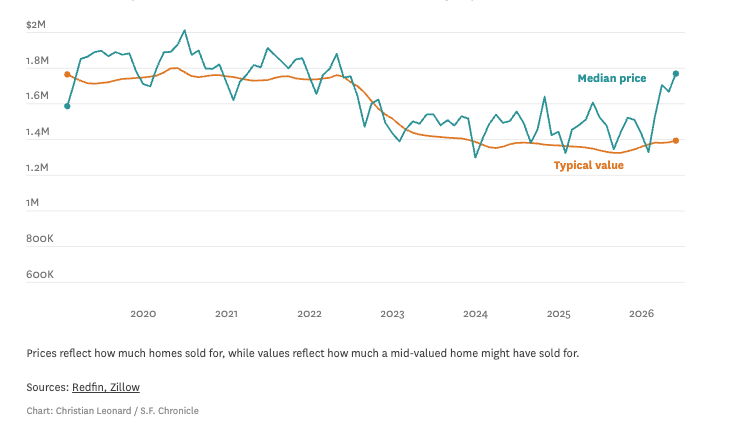
San Francisco’s once-chilly housing market has disappeared into the rearview mirror. The city’s median sale price hit a record high of $1.77 million in May, according to the most recent data from real estate brokerage Redfin. (Though that price was still below pre-2022 levels after adjusting for inflation). High-end neighborhoods like Pacific Heights and Noe Valley have led the charge, with some buyers offering seven figures above the list price.
“The feeling is that there’s never enough choice,” said Nina Hatvany, a real estate agent at Team Hatvany Kitchen at Compass. In the first six months of 2026, her team has made more deals than in the entirety of 2025. “Every new property is being jumped on.”
Part of the reason sale prices in San Francisco are so high is that luxury homes are the ones selling most briskly. Real estate listing company Zillow estimated that the typical home in the city — including properties that aren’t currently for sale — would fetch just about $1.4 million in June, much less than the homes that are actually changing hands. (Though even that figure was up from the December 2025 estimate of $1.34 million.)
S.F. median home sale price versus home value
Estimates are adjusted for inflation. Home value data is seasonally adjusted and smoothed
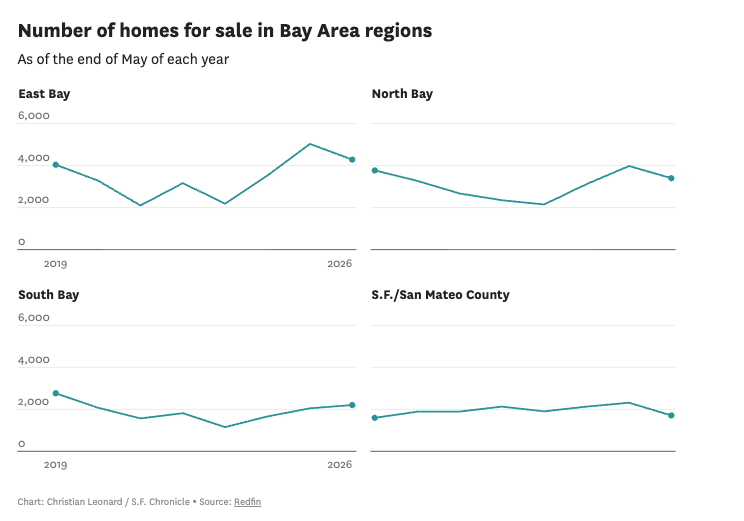
Home buyers have been snatching up properties faster than sellers have listed them, adding to the competitive environment. Arrian Binnings, a real estate agent at Christie’s International Real Estate Sereno, said that some sellers are probably holding out for prices to rise even more. But others don’t have a choice. Many homeowners, agents said, are sitting on a potential windfall, knowing that it still won’t be enough to cover the purchase of their next San Francisco property — especially at current interest rates.
The result is a large number of properties staying off the market, keeping competition high for those that list.
S.F.’s heat starts to spread
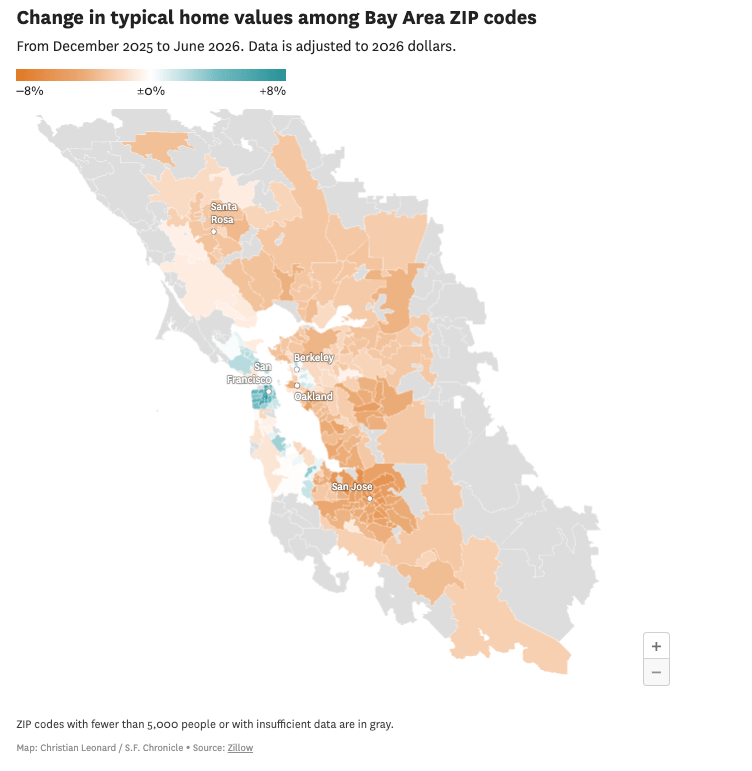
Cities within commuting distance of San Francisco have also picked up steam. Mill Valley and Burlingame have seen modest home value upticks this year, suggesting that some home buyers — either priced out of San Francisco or desiring a more suburban community — are starting to consider alternatives.
In the past, the location of tech jobs has led many newly-moneyed Bay Area home buyers further south to Silicon Valley, said Own Marin real estate agent Barr Haney. With the current AI boom focused on San Francisco, housing demand has instead spilled north.
“A lot of these buyers are coming over the bridge,” Haney said.
At last, some of those buyers are going over the Bay Bridge, too. Piedmont, Berkeley and Alameda continue to attract families to their strong school districts and smaller-town vibes, said Megan Micco, a real estate agent at Compass. Even Oakland, which has languished for the past few years, is seeing signs of life in its rental market. She predicts that San Francisco’s market heat will continue to spread into the East Bay next year.
Daniel Winkler, an Albany-based real estate agent, said the AI boom will bring back more demand than the Iran War and economic uncertainty have chased away. The glut of for-sale homes in Alameda County has started to drain. And new supply hasn’t budged much.
“The Bay Area just doesn’t build,” Winkler said.
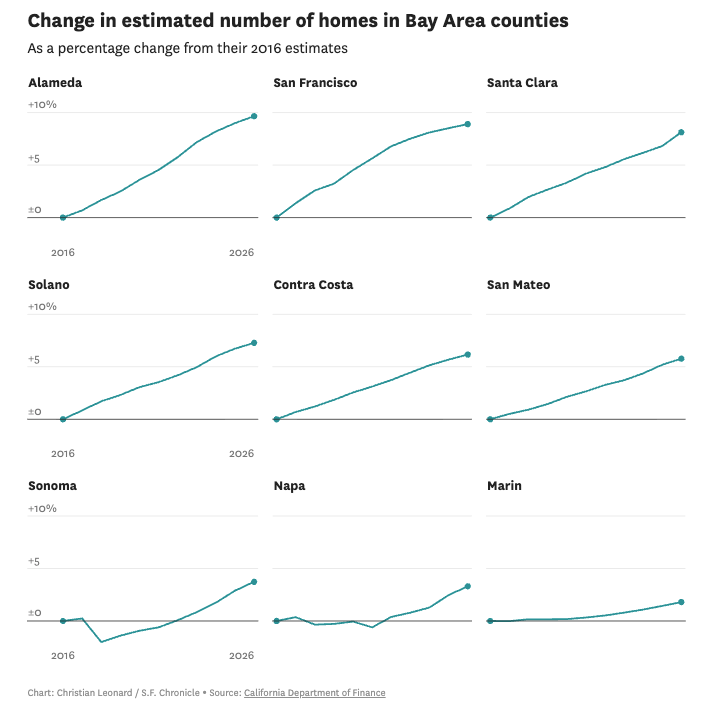
That’s upped the pressure on buyers, especially first-timers who don’t have a bunch of cash from a high-earning job or the sale of a previous home. Winkler said he’s been advising buyers to take advantage of Oakland’s drastically softened condominium market, while Micco recommends that buyers consider a smaller house, or one in a different neighborhood, rather than buy a condo.
The South Bay loses some shine
The 2026 housing market is a stark reversal from just a couple of years ago, when it was Silicon Valley and its satellite cities that were red-hot and San Francisco buyers had the most leverage.
But while San Jose’s and Santa Clara’s home values remain far above their 2019 levels, they’ve started to backslide. Typical home values in San Jose dropped nearly 5% from December to June, one of the largest drops in the Bay Area. Commuter cities like Dublin and Fremont, into which remote workers flooded during the pandemic, are now floundering.
The Trump administration’s immigration crackdown and broader economic uncertainty have eroded the buyer pool, which traditionally has included many people on work visas. And the number of AI workers remains relatively small and concentrated in San Francisco and the Peninsula, as opposed to the more traditional software and hardware jobs based around San Jose, which have been roiled by waves of massive layoffs.
“Silicon Valley is resilient, but only to a point,” said Nikki Edwards, a South Bay agent with EQ1 Real Estate.
Those headwinds should have set the stage for a buyer comeback, but many sellers have until recently refused to budge on their prices, said Sandy Jamison, a real estate broker at Tuscana Properties. Today’s buyers will pay a premium for modernized, well-maintained homes, she explained. But many listings are what she calls the “messy middle” — decent homes that were last renovated decades ago.
“That’s the equivalent of looking at a green shag carpet from the 1970s when you’re in the year 2000,” Jamison said. “These sellers want top dollar, but (their homes are) not in top dollar condition.”
More recently, Jamison added, some sellers have finally come to terms with the idea that Silicon Valley isn’t as hot as it used to be. The resulting dip in prices appears to finally be bringing some buyers back.
Cheaper markets have cooled even more — for now
The Bay Area’s more affordable cities, such as Oakland, Emeryville and Vallejo, as well as more distant areas in Sonoma, Napa and Solano counties, continue to see home values tumble at some of the fastest clips in the region.
That trend stretches back to 2022, when mortgage rates more than doubled in just a few months. Financing a home became a non-option for most households overnight.
That is, except for those wealthy enough to buy in cash. The Bay Area’s millionaires — many of them newly created by the AI boom — have spent their wealth competing for mansions, not condos, making luxury homes worth more even as homes in multi-unit buildings keep getting cheaper.
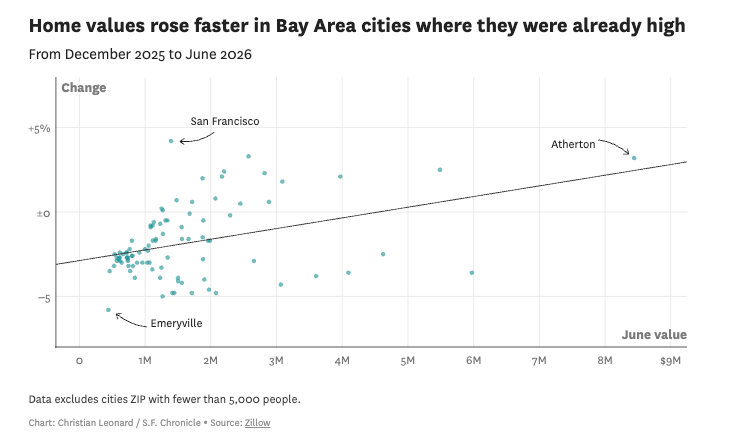
Even within cities, the divergence between upscale neighborhoods and working-class areas has widened. Homes in Oakland’s Rockridge neighborhood still attract fierce competition, while those in East Oakland or near Lake Merritt continue to decline.
Binnings, one of the San Francisco real estate agents, described the San Francisco market as “k-shaped” — split into two markets. Newly renovated houses attract intense competition from wealthy buyers, while “cookie-cutter” condominiums take much longer to sell, he said.
“The general wisdom would be, ‘A rising tide lifts all boats,’” Binnings said. “And I think that’s true, but I also think that it won’t lift all boats equally.”
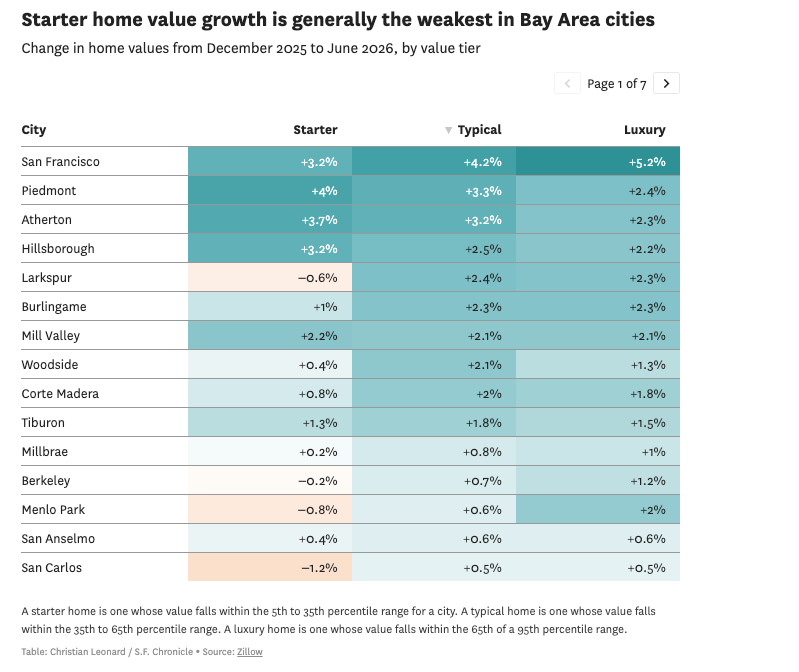
Those condos, especially in East Bay cities, may offer some of the few remaining opportunities for first-time home buyers. But there’s a catch: Buying a condo may be easier, but affording it is more difficult. Rising insurance premiums and delayed renovation costs are pushing monthly homeowners association dues up rapidly. That means that while sticker prices are lower, buyers may still have to pay more out of pocket than if they’d rented a similar unit.
Still, some real estate agents say it’s only a matter of time before the high prices in San Francisco spread further into the Bay Area, and into other types of homes. Many are predicting that when companies like OpenAI or Anthropic go public, the boom will get even bigger — and more households will be squeezed out.
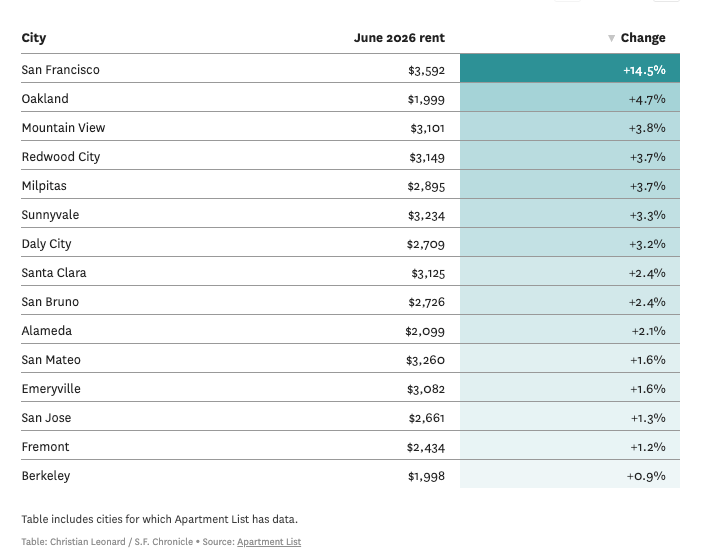
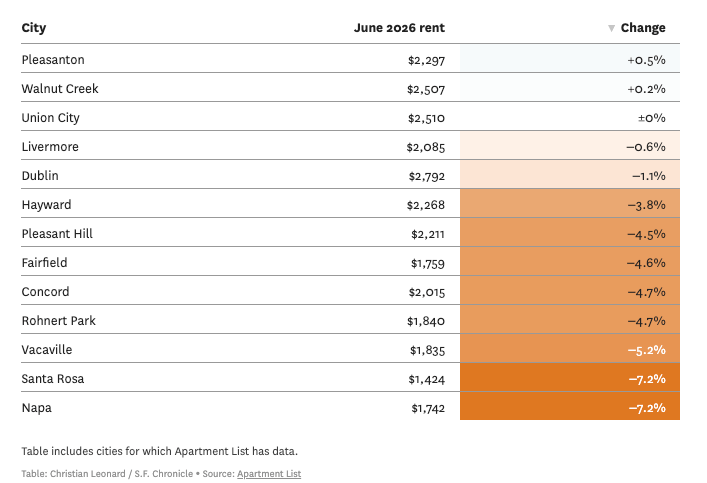
Tellingly, the headline-making rents in San Francisco have already begun to rise in Oakland and the Peninsula, according to data from Apartment List.
“It’s going to get crazier and crazier,” said San Francisco real estate agent Hatvany.
Author: Christian Leonard
Share:
