It’s not uncommon for San Francisco home sellers to get more money than they asked for. Bay Area homeowners often set their prices artificially low to attract more competition. When done right, this “price-to-entice” strategy can get a seller a few extra hundred thousand dollars.
But now, amid San Francisco’s rise as an epicenter for artificial intelligence wealth, some sellers are getting an extra zero on that bonus. From January through June, more than 140 San Francisco homes sold for at least $1 million above their asking price, according to data from real estate brokerage Compass. That included 44 sales in June alone. In the first six months of 2025, just eight homes fetched at least $1 million above asking.
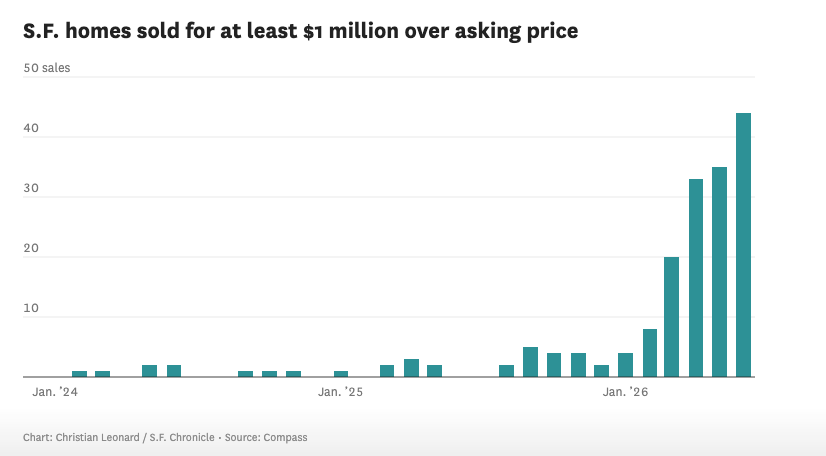
Mike Simonsen, Compass’ chief economist, called the data “absolutely bananas.” Demand for expensive homes in San Francisco has surged with the AI boom, he explained in a statement. In upscale neighborhoods like Noe Valley, the Richmond and Pacific Heights, bidding wars over “move-in ready” properties — which already tend to attract the most competition — are pushing prices to new levels.
The homes selling for seven figures above asking are a tiny fraction of the hundreds of San Francisco listings that change hands each month. But other data also indicates that the difference between the numbers on the for-sale sign and the final contract is widening. In May 2026, the average home sold for nearly 16% more than the list price, according to the most recent data from real estate brokerage Redfin. That was more than double the average of 7% in May 2025.
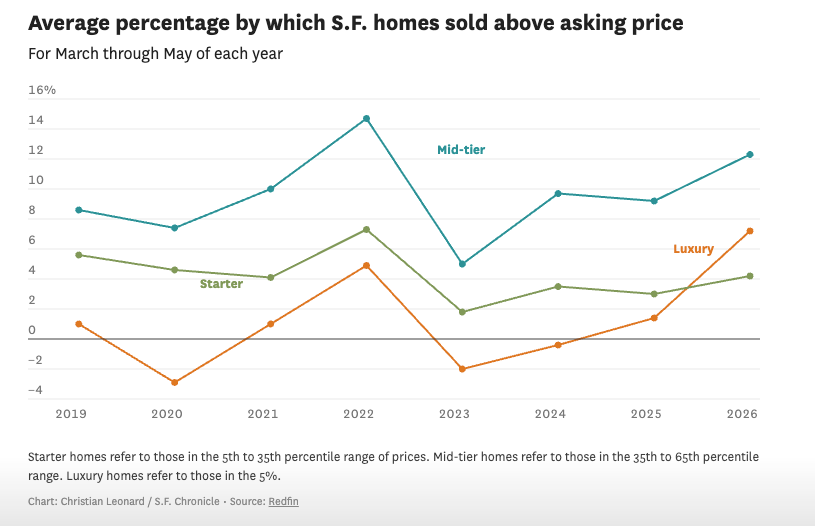
Not every kind of home is equally likely to sell above asking. Historically, it was actually mid-priced homes that had the strongest tendency to be listed well below where they sold. And even starter homes, the cheapest segment, regularly go for about 5% more than the sellers list them.
That’s all changing. From March through May, the amount by which mid-priced homes exceeded their asking price was the highest of any segment, at about 12% over asking, according to Redfin. But luxury homes — those priced among the top 5% of properties — saw the greatest jump year-over-year, selling on average for 7% more than asking in 2026, compared to less than 2% over the same period in 2025.
That means that for the first time in Redfin’s records, luxury homes in San Francisco are selling for more over their list price than starter homes.
While San Francisco’s luxury market is seeing the most heat right now, some of that demand could spill over into the midtier and starter-home segments. That would make finding an affordable house even more challenging for even upper-middle-income households, who are already staring down high mortgage rates and a shaky labor market.
The heated market also presents an obstacle for existing San Francisco homeowners attempting to move to a more spacious property. Higher home prices could give them a windfall if they sell — but then they’d have to contend with San Francisco’s latest crop of millionaires for a piece of San Francisco real estate.
As in other corners of the economy, homebuyers in the city may find themselves paying more for less.
Author: Christian Leonard
Share:
